


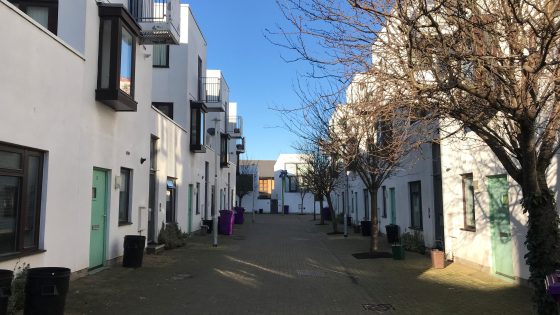
When Peter Barber’s Donnybrook Quarter was completed in 2006 it was hailed as ‘one of the most innovative housing projects to be undertaken in the UK for decades’. It made the Stirling Prize longlist, was exhibited at the Royal Academy, and won numerous awards.
The practice’s work is repeatedly cited as an inspirational demonstration of housing design excellence – humane, beautifully crafted, inhabited proof that it is possible to build excellent and innovative social housing in the 21st century.
Originally commissioned by Circle 33 Housing Trust, Donnybrook was the winner of a competition run with the Architecture Foundation and entered by 140 practices. Peter Barber describes his client as ‘fearless’, adding: ‘Donnybrook Quarter was something of a miracle. In a world of mediocre, corporatised, monetised, quick-fix housing, it was the product of genuine idealism.’
Now, however, Donnybrook is threatened. Circle 33 has been subsumed within Clarion Housing, and the new housing association owner has submitted planning applications to Tower Hamlets to replace all the existing double-glazed timber windows and doors with uPVC ones. Not only is uPVC hugely damaging in environmental terms, this change would have a devastating effect on the appearance of the estate.
Donnybrook isn’t fancy or dramatic architecture. The project’s success relies on its crisp forms and precise use of natural materials – sand cement rendered blockwork here, rather than the brick of most later Peter Barber projects – together with stained timber windows, carefully detailed to show their grain.
Particularly striking are the dozens of projecting oriel windows, used on every principal façade. The applications state that ‘the like-for-like visual match [of the proposed brown uPVC windows and doors] ensures minimal aesthetic impact on the street scene’, but this is clearly wishful thinking. Replacement in uPVC would coarsen the design and destroy its integrity from within and without. Donnybrook would not be Donnybrook without its windows.
There’s no evidence that refurbishment and repair of the existing timber windows has been seriously considered, and like-for-like replacement in timber is, of course, another option. The stats for the environmental impact of uPVC windows are a further compelling reason not to switch materials. Such windows generate 43 per cent more waste than timber, and 82 per cent of uPVC waste ends up in landfill, where it won’t biodegrade.
The use of dark timber connects the estate to the low-rise high-density estates designed under borough architect Sidney Cook for Camden, in the 1960s and 70s, such as Neave Brown’s Grade II*-listed Alexandra Road. However, while Alexandra Road, completed in 1978, was listed just 15 years later in 1993, practically no social housing built subsequently has been protected (for instance, none of the pioneering estates built for Lambeth under Ted Hollamby – such as Central Hill, Cressingham Gardens and Myatts Fields – are listed, even at Grade II).
The Twentieth Century Society is calling on Clarion to rethink its approach, and on Tower Hamlets to refuse consent for uPVC replacements. Listing Donnybrook would obviously be a sensible way to ensure the integrity of this special project is preserved. Donnybrook with uPVC windows would cease to be an exemplar of good housing practice. Instead, it would become an indictment of poor social housing management and a demonstration of just how fundamentally damaging and depressing ill-considered changes to estates can be.
Catherine Croft is director of the Twentieth Century Society
