


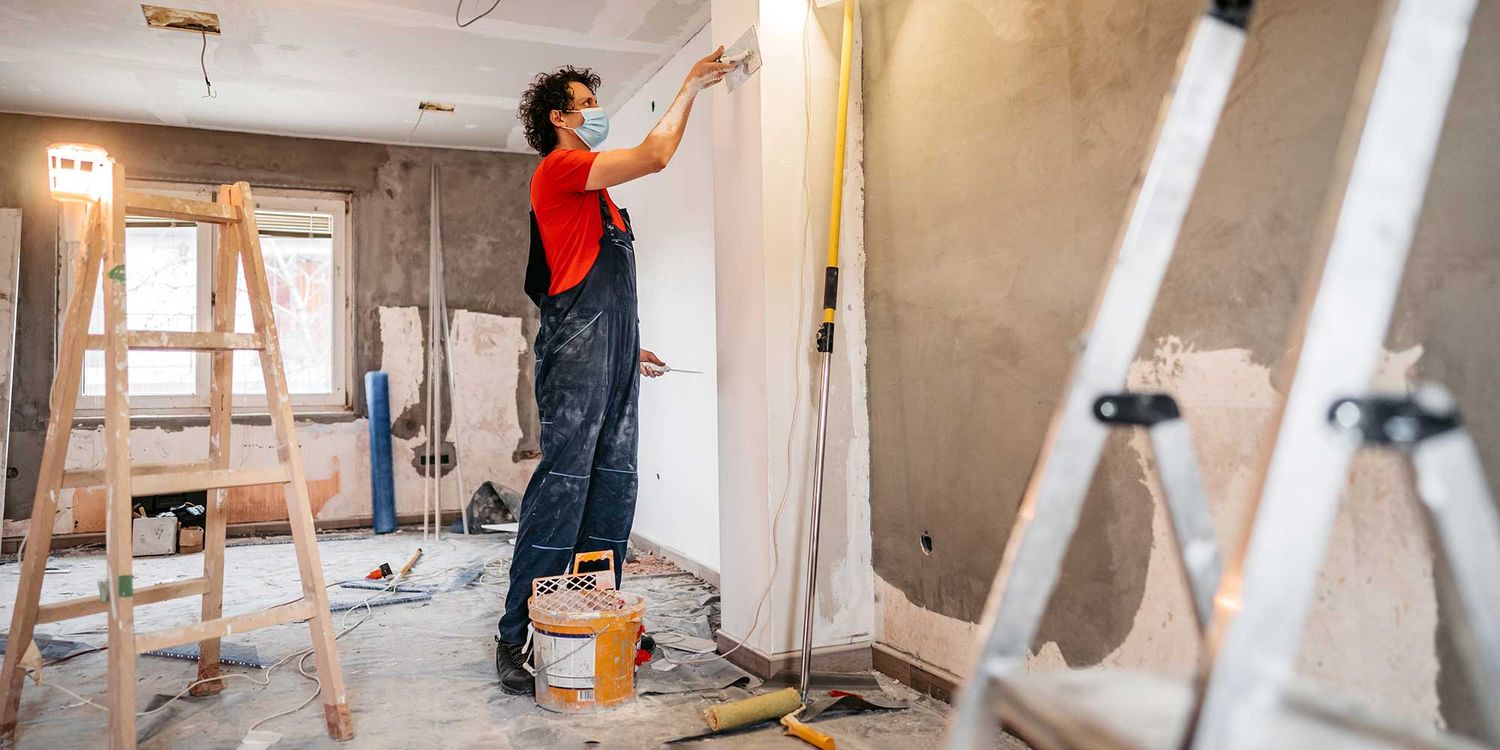
Plastering can seem like a daunting task for even the most proficient of DIYers. We’ve asked Which? Trusted Traders for their expert advice on how to plaster a wall, or just fix holes and cracks in plaster.
Bear in mind that plastering is a physically demanding job and can take practice to get right. If you have any concerns about any part of the job, from choosing the right plaster to plastering round tricky areas, speak to a professional.
Use Which? Trusted Traders to find a reliable professional near you
How to plaster a wall: step by step
In most cases, DIY plastering jobs involve plastering over old plaster or new plasterboard. If you’re plastering onto bare brick, the steps you’ll need to take are slightly different, as we explain later.
For plastering onto new plasterboard or already-plastered walls, follow these steps:
1. Get the room ready

Empty the room as much as possible of furnishings. You may also need to remove radiators, curtain rails and the like. If you’re plastering around electrical sockets or switches, tape over them to avoid plaster getting in, and turn off the electrics to the room.
Lay down dust sheets to protect floors and any items you can’t move out, and to collect debris.
2. Prepare the walls
If you’re plastering over new plasterboards, use joint tape over the seams between boards to give you as smooth a base as possible. If you’re plastering over already plastered walls, remove any old wallpaper and scrub and clean them down to remove any loose plaster, dust and grime. Small holes and cracks can be covered with joint tape.
3. Prime the walls
Apply a PVA adhesive over the entire wall, to help the plaster stick. Dilute as per the manufacturer’s instructions, and roll or brush the glue onto the wall. Wait for it to partially, but not completely, dry (it should still be a bit sticky when you apply the plaster). Be careful not to get PVA on any areas that you will be painting, as the paint will not adhere well.
As an alternative to PVA, Trusted Trader Jesse Petherick, of Decoforce in Stoke-on-Trent, uses Blue Grit from Febond, or a primer called SBR. He says both are ‘great to prime a wall for plastering’.

4. Mix the plaster
Pop on a dust mask as protection from the dry plaster. Fill a clean bucket with tap water and gradually add the plaster (don’t add water to the plaster). The manufacturer’s instructions will indicate the correct proportions of water to plaster; 50/50 is common.
Stir until the plaster mixture is smooth and free of lumps, making sure you incorporate any excess dry plaster from around the edges of the bucket. Ideally, use a power mixer on a slow speed to stir, as this will make your life much easier, though it is possible to do by hand. Clean the stirring tools as soon as possible to avoid the plaster drying and becoming harder to remove.
5. Apply the first coat of plaster
Use the plastering trowel to place some plaster onto a plasterer’s hawk board. Don’t overload the hawk board, as this will make it too heavy to hold very easily.
Pick up a small amount of plaster from the hawk board with the trowel. If you’re right-handed, work from the top left-hand corner of the wall, with even pressure, to spread the plaster firmly onto the wall. If you’re left-handed, you may find it easier to start from the top right. Hold the trowel at a slight angle away from the wall to start with, flattening it to the wall at the end of each stroke.
Continue working along the wall, filling from top to bottom before moving onto the next section. Overlap each new section slightly with the previous one to avoid gaps. Work as quickly as possible – you can even out trowel marks later.
6. Smooth bumps & gaps
Let the plaster dry for around 20 minutes, then go over it again with a trowel to smooth out marks and bumps. If the plaster has dried out too much, using a spray bottle to dampen it can help. Use a wet paintbrush to smooth out corners and edges.
7. Apply the second coat of plaster

Mix up a second batch of plaster. This will usually be a bit thinner than the first coat, to ensure a smooth finish – check the manufacturer’s instructions. Before the first coat has fully dried out, apply the second coat in the same way that you applied the first one.
Some people like to scrape the surface of the first coat of plaster using a devilling float or old kitchen fork before applying a second coat. This creates a rough texture that helps the next layer of plaster stick better.
You might read some advice that talks about ‘skimming’ a wall, which only requires one thin coat of plaster. While it does depend on circumstances, Trusted Trader Ross Stagg, of Plastering Stagg in Stockport, recommends two coats of plaster, as this will usually give you a better finish.
8. Smooth and polish
‘The flattening-off stage is the most important part of plastering,’ says Ross. ‘If you don’t get the plaster flat at this stage, then you’ll need to mix up and start the process again.’ He recommends the following multi-step process to smooth out the final coat of plaster:
- Wait till the plaster firms up a little bit, so it’s still wet but doesn’t stick to your fingers.
- Flatten out the plaster to take out any bumps or hollows. A tool known as a speedskim or xskim can help with this.
- Use a wet trowel to take out any tiny, final imperfections.
- Go over with a wet trowel once more, to get the wall feeling smooth.
- ‘Polish’ the plaster with a dry trowel, to take out any last watermarks and make the plaster feel super-smooth, ready for painting.
Ross recommends that DIYers consider mixing a product called Extratime Plaster Retarder into the plaster before applying it to the wall. It slows down the plaster setting time by up to 60 minutes, which buys you more time to get a good finish.
What do you need to plaster a wall?
- Plaster
- PVA adhesive
- Joint tape – to cover gaps between plasterboards or any small holes or cracks in old plaster
- Large bucket
- Plastering trowel – stainless steel is best
- A speedskim or xskim tool
- Plasterer’s hawk board – the tool that holds your plaster (you can get them in plastic or wood – plastic is lighter, but a wood board will last longer)
- Paddle mixer
- Plastering brush (or a decent paintbrush will do the job too)
- Spray bottle
- Sandpaper
- Dust sheets
- Dust masks
- Cutting knife
- Emulsion roller and tray
- Board finish plaster
- Cloth/rags – to clean tools and any stray plaster
- Devilling float or old fork (optional) – to score the surface of the first coat of plaster before adding a second

Wondering where to buy everything you need to plaster a wall? Check out our guide to the best DIY and decorating shops, according to our research
How to plaster a brick wall
‘There are two ways to plaster a brick wall,’ says Ross. ‘The traditional method is to use a back-coat plaster – hardwall, or sand and cement. Or the new, faster method is to dry-line the wall in plasterboard, using an adhesive to stick the plasterboard to the wall.’
Whichever method you use, you then apply regular plaster over the top.
How to plaster a damaged wall
If most of a wall is in reasonable nick but there are some unsightly cracks or holes, you may only want to patch up the damaged part with plaster. We asked the experts for their top tips.
How to fix a hole in the wall with plaster
There’s no hard and fast way to do this. The circumstances – such as the depth of the hole – will dictate what to use.
‘If an electrician has chased through to the brick, for example, then you’ll need a bonding coat, or back coat, followed by finishing coats of plaster,’ says Jesse.
‘If removing wallpaper has moved some plaster away, then a multi-finish plaster would be appropriate.’

How to fix a plaster wall crack
As with fixing a hole, there’s no single way to do this. Jesse says good practice is to ‘use a raking tool or sharp knife and chase the crack out to no more than 1-3 mm deep. Clean dust out of the crack. With a precision brush, carefully apply diluted PVA or a water-based sealer called Zinsser Gardz into the crack to seal and prime the area.
‘Use filler rather than multi-finish plaster for cracks, as it will dry quicker and sand better. Apply two coats of filler in the crack, then sand once it’s dry.’
The fillers Jesse recommends are Toupret, or Gyproc Easifill (20, 40 or 60). You can buy pre-mixed tubs of filler, but they may take longer to dry.
How long does it take to plaster a wall?
Assuming there’s not too much preparation required, plastering a wall would take a professional about four hours on average, depending on the size of the wall. A whole room would take a couple of days. For a first-time DIYer, though, it’s likely to take longer, so allow yourself at least three days for a full room.
The time taken for a plastered wall to dry various depending on several factors, including:
- The thickness of the plaster – a thicker coat will take longer to dry.
- The humidity of the room – greater humidity will mean a longer drying time.
- The temperature – plaster will dry faster on a hot summer’s day than it will in the depths of winter.
Generally, you can expect a plastered wall to take a minimum of five days to fully dry in the summer, in good drying conditions, but it could take two weeks or more in some cases.
How can I speed up plaster drying?

You can speed up drying in poor conditions by improving ventilation – use a dehumidifier if the air is damp, and a heater if it’s very cold. Don’t whack the heat up too high, though – around 15℃ is best. If the plaster dries out too fast, it could crack and ruin your hard work.
You can usually tell when plaster is dry and ready to paint when the whole area turns from a brown to a pale pink colour. If in doubt, leave it a bit longer, because painting onto plaster before it’s ready is likely to cause the paint to flake off.
For our expert product recommendations, consult our guides to the best dehumidifiers and best electric heaters.
How to paint a freshly plastered wall

After waiting days or weeks for plaster to dry, you might be keen to slap the first coat of paint on as soon as you can, but applying paint directly on to bare plaster risks the plaster absorbing moisture from the paint, which can cause cracking.
It’s a good idea to apply a ‘mist coat’ to the freshly dried plaster, which acts as a primer. This is simply a watered-down emulsion paint – roughly a 50:50 ratio of water to paint (it needs to be quite thin). Many white emulsions include details of the best ratio for a mist paint, so it’s worth checking.
Mix up the mist paint in a clean bucket, then use either a roller or paintbrush to apply it evenly to the plastered area. Leave to dry for 24 hours before applying your top coats.
Getting mist coat ratios wrong can risk them failing, warns Jesse: ‘As a professional, I would recommend an actual primer for new plaster walls. It’s slightly more expensive, but offers reassurance. I recommend either Zinsser Gardz or Tikkurila Optiva Primer.’
What is dry lining a wall?
Dry lining a wall is a faster and cleaner alternative to traditional wet plastering. You attach plasterboard to a wall, finish it with joining compound and joining tape, then paint or wallpaper straight onto it.
It probably won’t give as good a finish as a professionally plastered wall, but it can be easier for beginners to achieve a decent result. If you’re not happy to paint straight onto the plasterboard, you can add a skim-coat of plaster over the top.
Dry lining is more expensive than plaster alone though, and it will lose you a few centimetres from the size of the room.
If you need a professional, use Which? Trusted Traders to search for a reliable tradesperson in your area:
Read more here: Click Here
