


Image source, Wilton Park
-
- Author, Hsin-Yi Lo
- Role, South East
Located in a secluded area of the South Downs, stands an impressive 16th Century stately building which has been the centre of promoting international peace.
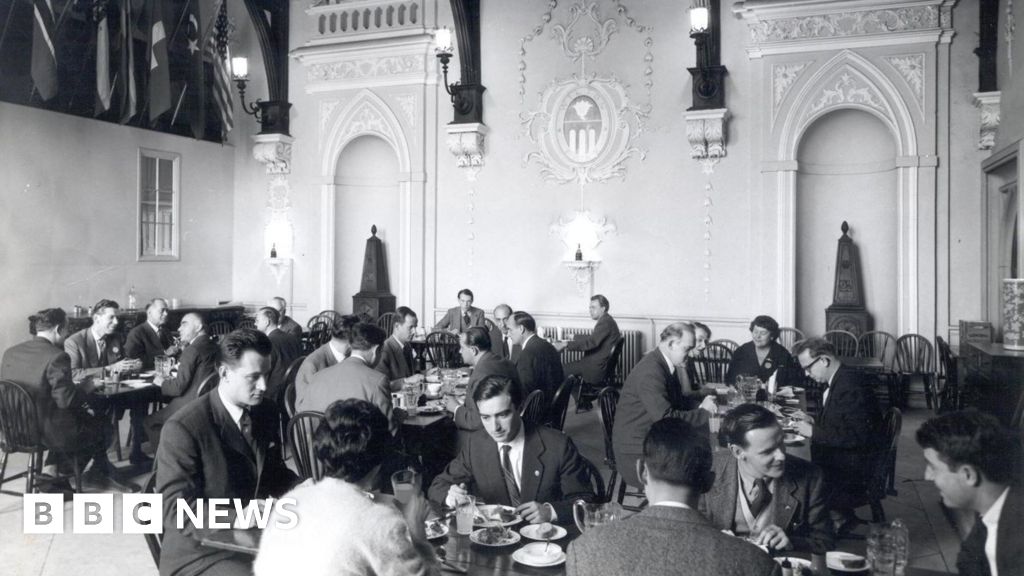
Wilton Park, based in Wiston House in Steyning, West Sussex, was established as part of plans to re-establish peace and democracy in Europe following World War Two.
Formed under the Labour government in January 1946, the institution has its foundations in providing educational programmes for German prisoners-of-war (POW) and civilians.
Subsequently, Wilton Park has hosted numerous global forums including the European Union expansion, transitioning from the Apartheid regime and the impact of the Soviet Union reforms on East Europe.
Image source, Wilton Park
Contemporary Europe historian, Holger Nehring, told the BBC Wilton Park’s location is a suitable place for global forums given its secluded location.
“This gives decision-makers a chance to have open and frank discussions,” he added.
“When Wilton Park started as a education centre for POWs and German citizens, it did not impose how democracy and governance should operate in post-war Germany.
“They taught them about German democratic institutions and traditions, and German historians were involved in the education.”
The focus was also about re-building Anglo-German diplomatic relations following the war.
Nehring said this approach was important as it established Wilton Park as an institution which promoted cooperation and reconciliation.
Image source, Wilton Park
Tom Cargill, chief executive of Wilton Park, described Sussex as the “perfect home” for Wilton Park.
“It’s connected to the world, has world-class nature and culture, and presents the best of Britain to senior guests from around the globe,” he said.
“Sussex should be proud of the role it has played in supporting international diplomacy, it’s a critical hub for working on the world’s toughest challenges.”
Image source, Wilton Park
Wilton Park has been visited by prominent politicians and leaders including Lady Astor, Prince Philip, the then Prince Charles, former West German Chancellor Helmut Schmidt and actress Angelina Jolie.
Wilton Park commemorates its 80th anniversary this month.
Chairperson of the institution, Gisela Stuart, said: “Wilton Park shows the enduring power of open dialogue, that open discussions between former enemies is possible,”
Image source, Wilton Park
“Wilton Park has been keeping up with ever-changing world events and emerging trends that impact global security and stability,” Stuart added.
These include hosting forums focusing on climate change, vaccinations, the potential impact of artificial intelligence and the political and economic consequences on the Russia-Ukraine conflict.
Image source, Wilton Park
-
- Author, Hsin-Yi Lo
- Role, South East
Located in a secluded area of the South Downs, stands an impressive 16th Century stately building which has been the centre of promoting international peace.
Wilton Park, based in Wiston House in Steyning, West Sussex, was established as part of plans to re-establish peace and democracy in Europe following World War Two.
Formed under the Labour government in January 1946, the institution has its foundations in providing educational programmes for German prisoners-of-war (POW) and civilians.
Subsequently, Wilton Park has hosted numerous global forums including the European Union expansion, transitioning from the Apartheid regime and the impact of the Soviet Union reforms on East Europe.
Image source, Wilton Park
Contemporary Europe historian, Holger Nehring, told the BBC Wilton Park’s location is a suitable place for global forums given its secluded location.
“This gives decision-makers a chance to have open and frank discussions,” he added.
“When Wilton Park started as a education centre for POWs and German citizens, it did not impose how democracy and governance should operate in post-war Germany.
“They taught them about German democratic institutions and traditions, and German historians were involved in the education.”
The focus was also about re-building Anglo-German diplomatic relations following the war.
Nehring said this approach was important as it established Wilton Park as an institution which promoted cooperation and reconciliation.
Image source, Wilton Park
Tom Cargill, chief executive of Wilton Park, described Sussex as the “perfect home” for Wilton Park.
“It’s connected to the world, has world-class nature and culture, and presents the best of Britain to senior guests from around the globe,” he said.
“Sussex should be proud of the role it has played in supporting international diplomacy, it’s a critical hub for working on the world’s toughest challenges.”
Image source, Wilton Park
Wilton Park has been visited by prominent politicians and leaders including Lady Astor, Prince Philip, the then Prince Charles, former West German Chancellor Helmut Schmidt and actress Angelina Jolie.
Wilton Park commemorates its 80th anniversary this month.
Chairperson of the institution, Gisela Stuart, said: “Wilton Park shows the enduring power of open dialogue, that open discussions between former enemies is possible,”
Image source, Wilton Park
“Wilton Park has been keeping up with ever-changing world events and emerging trends that impact global security and stability,” Stuart added.
These include hosting forums focusing on climate change, vaccinations, the potential impact of artificial intelligence and the political and economic consequences on the Russia-Ukraine conflict.
For more information, visit MyTradeLinks.
