


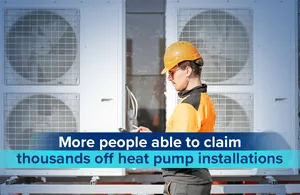
Industry experts praised the expansion of the funding as a ‘powerful signal’, but echoed calls for energy price reform
The UK Government has confirmed a major expansion of the Boiler Upgrade Scheme (BUS), widening the flagship decarbonisation programme to include air-to-air heat pumps and heat batteries for the first time.
The move, which has been long anticipated but subject to speculation, has been met with broader support across the heating, ventilation and renewables sectors, with industry leaders calling it a decisive step towards mainstreaming low-carbon heating.
The update, announced by the Department for Energy Security and Net Zero (DESNZ), introduces a £2500 grant for heat battery installations and broadens the existing heat pump grant to cover air-to-air systems.
Ministers say the policy is designed to extend consumer choice, accelerate decarbonisation, and help households keep cool in increasingly hot summers as well as warm in the winter.
Russell Dean, residential product group director at Mitsubishi Electric, welcomed the announcement as a clear signal that the UK is serious about making heat pumps mainstream and expanding the Boiler Upgrade Scheme to include air-to-air systems is a smart step that will open the door for more households to adopt more environmentally friendly heating and cooling.
“Rebalancing energy costs is essential if we want to unlock the full potential of heat pumps and deliver genuine savings for families. We need to ensure more homes can confidently switch to efficient, low-carbon heating that cuts bills as well as emissions”, he said.
However, Mr Dean warned that if we want to see “real momentum, we still have to tackle the UK’s energy pricing”, citing recent research that found a third of homeowners would consider moving to a heat pump if running costs were reduced by removing levies from electricity, adding that “as long as electricity remains far more expensive than gas, many homeowners will continue to hesitate, no matter how attractive the upfront incentives are”.
Dean’s call reflects longstanding concerns over the ‘spark gap’ between electricity and gas prices, which remains a significant barrier to heat pump adoption.
Mark Smale, head of renewables at Bradfords Building Supplies, also hailed the decision to include air-to-air systems, which are “not only more cost-effective for households, but also highly adaptable and importantly familiar, using the same technology as air conditioning”, adding that the key lesson his company has learned from its partnerships with developers, installers and builders its that “choice is paramount when it comes to uptake”.
Kat Young, practice manager for heat policy at Energy Systems Catapult, described the expansion as a significant boost to consumer choice and system efficiency:”The technology best-suited for decarbonising each of our homes will vary but achieving affordable, low-carbon warmth must be the goal” she said, adding that “Thanks to their significantly higher efficiencies, air-to-air heat pumps can be a powerful tool to tackle fuel poverty for households currently using direct electric resistive heating, as the upfront cost and disruption can be significantly lower than installing a new wet central heating system”
With overheating in summer increasingly becoming a national health concern, air-to-air heat pumps also offer the additional benefit of cooling, allowing people to stay comfortable sustainably.”
Ms Young also stressed the importance of technical standards for heat batteries, time-of-use tariffs, and strong consumer protection frameworks, particularly as newer models such as ‘Heat-as-a-Service’ contracts gain more traction.
However, she warned that these business models need to operate within a strong policy framework of consumer protection, “which is not yet in place”, commenting “we look forward to working with government and industry to make this a reality.”
The Association for Decentralised Energy (ADE): Demand, the UK’s largest thermal storage trade body, said the decision was a “massive moment” that would be transformative for grid flexibility and consumer savings.
The association said the new £2,500 heat battery grant, which recognises heat batteries as “zero-emission boiler alternatives” capable of absorbing cheap renewable electricity, storing it, and delivering heat and hot water on demand, will enable homes to act as “thermal stores” which can absorb excess renewable power when it’s “cheap and green”, rather than wasting it.
Ms Honan praised the flexibility of these energy systems as vital for balancing the grid, helping avoid costly grid upgrades and delivering an estimated £115 a year in savings for households in this Parliament.
“Heat batteries mean we can stop wasting Britain’s renewable energy and start using it – this is how we cut bills and carbon” she said. “Now, the Chancellor must act, Rachel Reeves must extend the 0% VAT to heat batteries in the Budget and take decisive action to lower electricity costs for good. It’s time for Government to back this British success story and deliver a cleaner, cheaper energy system.”
NAPIT’s commercial & compliance director Stephen Melton also welcomed the update, saying it would expand the number of households able to benefit from low-carbon technologies and “provide alternative solutions to the varying types of housing stock across the UK, as we all move towards the electrification of heating”.
Mr Melton added that NAPIT members are at the forefront of this transition, so this latest move “could add further benefits to their growth and expansion… we look forward to greater clarity and certainty around the scheme, which is something our members, UK homeowners and the wider industry needs.”
DESNZ says the reforms are part of its wider strategy to electrify heat, protect households from volatile fossil fuel markets, and reduce strain on the grid through demand-side flexibility.
In particular, air-to-air heat pumps, which are commonly found in countries such as Italy and Spain but have been slow to gain traction in the UK, are expected to benefit homeowners in smaller or electrically heated properties, or where retrofitting a wet system is impractical.
Heat batteries, meanwhile, are set to play a growing role in smoothing peaks and troughs in renewable generation, helping the UK build a more flexible energy system.
While industry figures broadly agree that the expansion of BUS is a positive milestone that increases choice, improves affordability, and acknowledges the UK’s diverse housing stock, the sector almost unanimously states that rebalancing electricity prices against gas is critical for the heat pump market to continue to grow.
As installers, merchants, manufacturers and policymakers digest the announcement, it seems that while momentum is building the full potential for the BUS to achieve hheat decarbonisation will only be unlocked through a fairer energy pricing framework.
H&V News will continue to follow developments as further details emerge, so please do get in touch with your thoughts.
Read more here: Click Here
